
Our call: Iceland stays out, at about 65%. That is a softer call than the one we made on Ireland, and it goes the opposite way to the market — Polymarket prices Iceland at 56% to compete, the most optimistic figure of any 2026 boycotter.

18+ | New customers only | T&Cs apply | Please gamble responsibly
The reason we land where we do is not politics. It is a calendar problem, and it comes down to one board meeting that may not even have Eurovision on the agenda.

What RÚV has actually said
Very little, which is the point.
The chair of RÚV's board, Stefán Jón Hafstein, says there has been “very little” discussion among the board about participation so far. No decision has been taken. The board next meets at the end of September, and — per reporting on 24 August — it is not clear whether Eurovision will be discussed at that meeting at all.
The EBU application deadline is mid-October.
Line those three facts up and the shape of the problem is obvious.
The clock
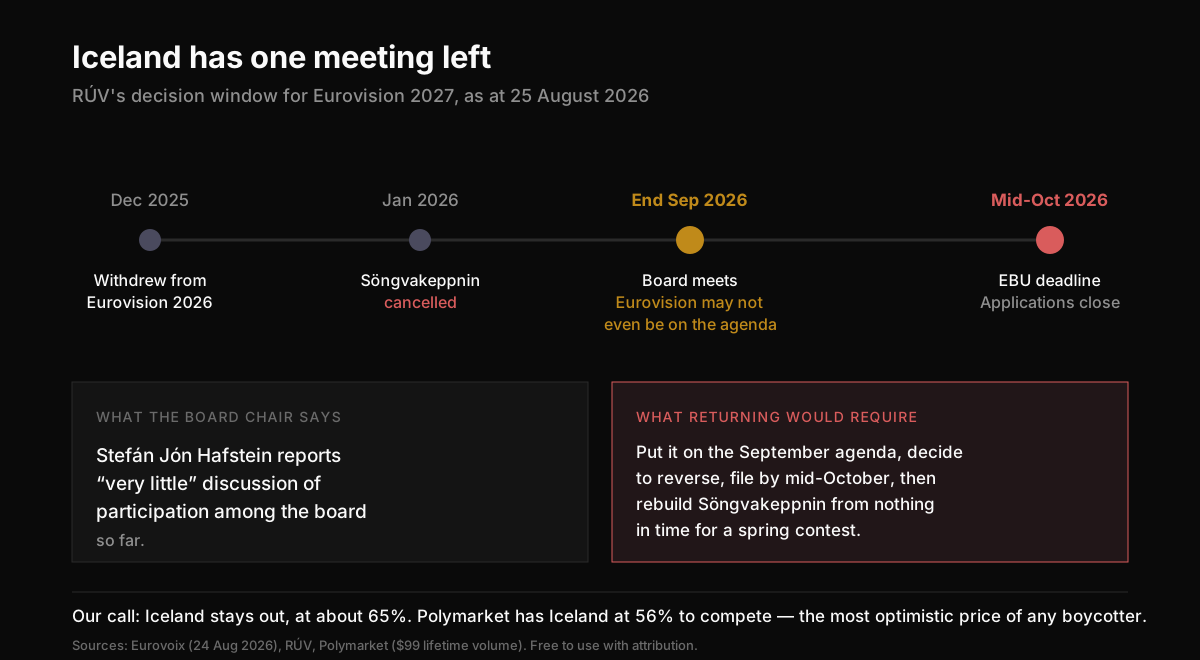
This is the same structural asymmetry we identified in Ireland, but sharper, because in Iceland's case you can point at the specific meeting.
For Iceland to compete, four things have to happen in sequence inside about six weeks: Eurovision gets onto the September board agenda; the board decides to reverse a public position; RÚV files with the EBU by mid-October; and then the broadcaster rebuilds Söngvakeppnin — cancelled in January 2026, with no decision taken on its future — in time to produce an entry for a May contest.
For Iceland to stay out, the September meeting simply covers other business.
“Very little discussion so far” six weeks before the only scheduled decision point is not the profile of an organisation preparing to reverse itself. It is the profile of one that has moved on.
Why we are still only at 65%
Iceland has a genuinely stronger pull back than Ireland does, and it would be dishonest to pretend otherwise. This is why our number is 65 and not 85.
Söngvakeppnin is a bigger domestic asset than Eurosong. Ireland's national final is a modest broadcast; Iceland's is a multi-week tentpole in a small television market, with an audience share Irish producers would find surreal. RÚV did not just lose an entry when it withdrew — it lost a chunk of its winter schedule. That is a programming argument for returning that has nothing to do with the politics, and it is the kind of argument that wins internal meetings.
Iceland's Eurovision culture runs deeper. A country of under 400,000 that produced Hatari and Daði Freyr has an unusually intense relationship with the contest. Public appetite for a return is likely higher, per capita, than anywhere else on the boycott list.
Nothing has been ruled out. Unlike AVROTROS, RÚV has made no 2027 statement at all. An undecided broadcaster with a scheduled meeting is a live question, not a closed one.
The board could simply take it up. “Not clear whether it will be discussed” is not “it will not be discussed.” If a board member puts it on the agenda, the decision happens on time.
Why we still think out
Against that: the stated reason for leaving has not changed. Israel is confirmed for 2027, the contest director has ruled out further exclusion votes, and the EBU reform package was judged insufficient by AVROTROS yesterday on a near-identical objection. There is no new fact for a September board to respond to.
And the Söngvakeppnin argument cuts both ways. Rebuilding a cancelled multi-week format from a late-September decision, with submissions, heats and a final to stage before spring, is a serious production ask. The show being valuable is a reason to want it back; it is also a reason the timeline is tight.
The deciding factor for us is the silence. A broadcaster planning to return in October would ordinarily have started signalling by now — sounding out songwriters, floating dates, letting the national final's future be reported as under discussion. Instead the board chair's on-record description is “very little” discussion.
On disagreeing with the market
We make Iceland about 35% to compete. Polymarket has 56%. That is a wide gap, and we are stating it a day after being wrong about the Netherlands in exactly this kind of market.
So, the honest framing.
That contract has traded $99 in its entire lifetime. It is not a considered market view; it is close to a coin-flip default that nobody has had reason to move. Yesterday's lesson was that a thin market can still be right and a media scoop can still be wrong — not that thin markets are informative. The Netherlands contract had real disagreement priced into it. This one has ninety-nine dollars.
Our disagreement here rests on a documented calendar constraint and an on-record quote from the person who chairs the board, not on a report of an unannounced decision. That is a better class of evidence than we were working from on Sunday. It is still a view, not a trade.
What would change our mind: any confirmation that Eurovision is on the September agenda, or any reporting that RÚV has approached songwriters or scheduled Söngvakeppnin slots. Either would flip this quickly.
Quick answers
Will Iceland be at Eurovision 2027? Undecided. RÚV has taken no position. Our view is that Iceland stays out, at roughly 65% confidence.
When will Iceland decide? RÚV's board next meets at the end of September 2026. It is not confirmed that Eurovision is on the agenda. The EBU deadline is mid-October.
Why did Iceland withdraw? RÚV was one of five broadcasters that boycotted Eurovision 2026 over Israel's continued participation, announcing its withdrawal in December 2025.
Is Söngvakeppnin coming back? It was cancelled for 2026 after the withdrawal. No decision has been made about future editions.
What do the markets say? Polymarket has Iceland at 56% to participate, on $99 of lifetime volume. We disagree, and we would not treat that as a tradeable edge.
Where do the other boycotters stand? The Netherlands is out at broadcaster level, Ireland is leaning out, and Spain and Slovenia are undecided — full detail on our participation board.