
Two of the broadcasters that could have rescued a Dutch Eurovision entry closed the door within a day. KRO-NCRV and BNNVARA have both ruled out taking over the Netherlands' participation, hours after AVROTROS confirmed its own withdrawal and handed the mandate back to NPO. The EBU, meanwhile, has issued a statement that is more revealing for what it concedes than what it says.

18+ | New customers only | T&Cs apply | Please gamble responsibly
We wrote yesterday that the Dutch question was still open because the mandate had moved rather than died. That is still true. It is a good deal narrower than it was.
Who is left
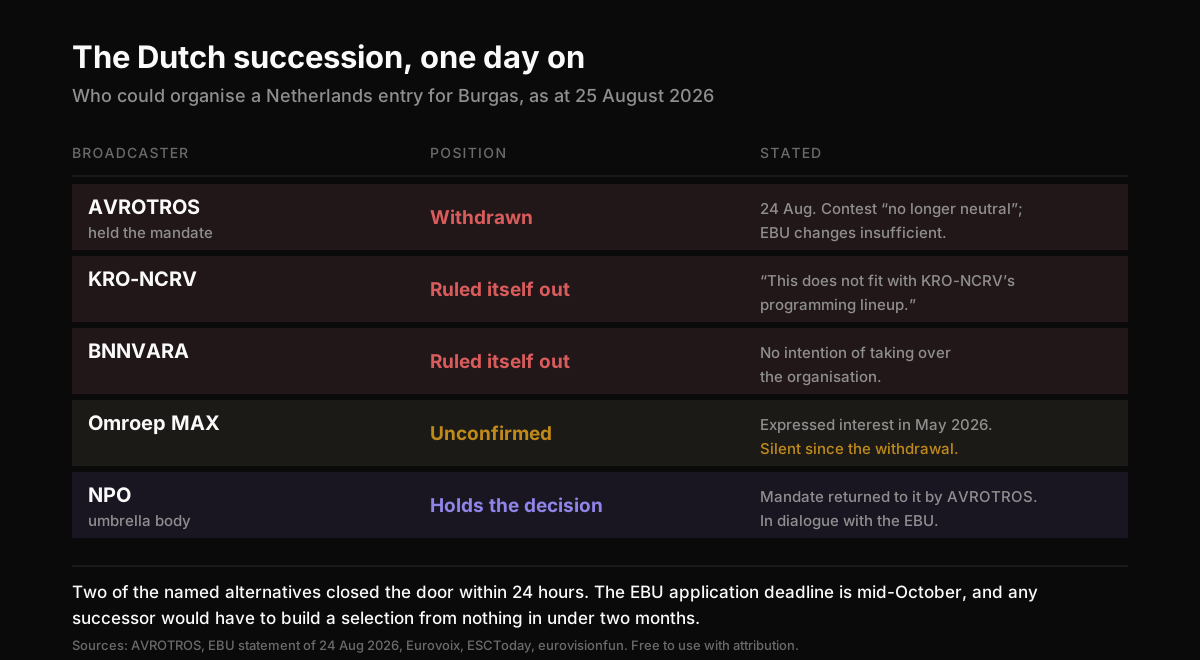
KRO-NCRV was blunt and, notably, non-political: “In terms of programming, this does not fit with KRO-NCRV's programming lineup, so we have no plans for it.” That is a scheduling answer, not a moral one — which matters, because it means the refusal would likely hold even if the political dispute evaporated tomorrow.
BNNVARA has said it has no intention of taking over the organisation either.
That leaves Omroep MAX, the broadcaster that spent the spring being talked about as the willing successor, having reportedly called the 2026 withdrawal a mistake. It has said nothing publicly since AVROTROS actually withdrew. In a story moving this fast, a day of silence from the one organisation everybody is looking at is itself information — though not yet enough to draw a conclusion from.
And the decision does not sit with any of them. It sits with NPO.
What the EBU actually said
Martin Green, the contest's director, issued a statement that is worth reading closely:
“We regret AVROTROS' decision to no longer participate in the Eurovision Song Contest but understand their choice and respect the views of our member broadcasters.”
He added that the contest “has always been a place to bring people together, celebrate diverse communities, and show that a better world is possible even in the most difficult times,” and confirmed the EBU will continue talking to NPO about the possibility of another broadcaster stepping in.
Three things stand out.
“Understand their choice.” That is a notably soft formulation. The EBU is not disputing AVROTROS's reasoning or defending the reform package it was judged against. Contrast it with the firmness the organisation has shown on the underlying question — there will be no further votes on Israel's participation. The EBU is conceding the withdrawal while conceding nothing on the cause.
The EBU is actively shopping for a replacement. Green said organisers would investigate whether another Dutch broadcaster might be willing. That is a governing body doing succession work on a member's behalf, in public, the day after a withdrawal. It tells you how much the EBU wants a Dutch entry on the board — and, read the other way, how thin the confirmed field is starting to feel.
There is no deadline flexibility in it. Nothing in the statement suggests the mid-October application date moves for the Netherlands. Whoever takes this on has under two months to accept a mandate, budget it, and build a selection.
Why a successor is harder than it sounds
“Another broadcaster could just do it” is the easy assumption. Work through what it actually involves.
A successor has to take on the EBU participation fee and the delegation costs, find them in a budget already set for the year, and do it for a contest a large slice of the Dutch public broadcasting sector has just publicly declined on principle. It has to build a selection process from nothing before mid-October, or pick internally and absorb the criticism that comes with that. And it does all of this knowing it is stepping into a role that AVROTROS vacated on moral grounds — which means every piece of coverage frames it as the broadcaster that was willing.
KRO-NCRV's answer is the tell. When you are looking for a way out of a politically awkward request, “it doesn't fit our programming” is the cleanest exit available, and it does not commit you to a position on anything.
What this changes for the 2027 field
Yesterday we listed the Netherlands as out at broadcaster level but genuinely open at country level. Today that gap has narrowed but not closed.
The honest read: a Dutch entry in Burgas now requires Omroep MAX, or a broadcaster nobody has named, to volunteer within weeks. That is possible. It is no longer the comfortable fallback it looked like on Friday, and anyone still treating the Netherlands as roughly even money to appear should mark it down.
We are not going to attach a number to it. The Polymarket contract on Dutch participation has traded under a thousand dollars in its lifetime, we were wrong about this exact market yesterday, and the resolution question — whether “Netherlands participates” covers a substitute broadcaster — is precisely the ambiguity that is now live. Read the resolution criteria before you touch it.
For the rest of the picture, our participation board tracks all 21 confirmed, 3 out and 10 undecided. Of the other four 2026 boycotters, Ireland and Iceland both now have pieces of their own.
Quick answers
Is the Netherlands definitely out of Eurovision 2027? AVROTROS is. The country is not formally out, because NPO can still delegate the entry to another public broadcaster. That is now much harder than it looked.
Which broadcasters have ruled themselves out? AVROTROS has withdrawn; KRO-NCRV and BNNVARA have both said they will not take over the organisation.
Could Omroep MAX still do it? Possibly. It expressed interest in May 2026 but has not commented since the withdrawal was confirmed.
What did the EBU say? Martin Green said the EBU regrets the decision but understands and respects it, and that it will keep talking to NPO about another broadcaster taking part.
When does this have to be settled? EBU applications close mid-October 2026. The contest is 11, 13 and 15 May 2027 in Burgas.